Irondean - One more Iron Madman

This is the training blog for Dean Sakihama. I’m not a health nut. I’m a distance junkie. The healthiest things I’ve done in my life are shortening my commute, leaving toxic jobs, finding good friends, and taking up running. In the triathlon world I fell in love with long distances.

Thursday, February 08, 2007

Race Report : 2006 Ironman California

I went to the Ironman California 70.3 race in 2006, not as a participant, but as a volunteer. I remember feeling like I wasn't ready to race in a field like that. My brain just said no. Top that off with not wanting to pay the entry fee but wanting to learn something from racing and voila, what do you have a ready-made volunteer. Volunteering is a wonderful experience and at the very least yields some excellent race day karma. It also let me follow my ironteammates through their race day, from the swim start, through transition, and in to the finish. Oh, and a free t-shirt too.

All right, now let's get down to it.
The weekend. An educational experience. What did I learn on race day?
  1. Be careful of where you’re standing before the start of the race. I actually saw a pro warming up by jumping up and down on top of one of the timing mats before they got in the water for the swim. (That’s just silly.)
  2. That water, between 52-57 degrees (depending on who you talked to), really was cold enough for people passing through T1 to stop for warm blankets and to pull out of the day.
  3. The biggest thing I saw over the course of the day was planning. Plan your day. It’s the one thing (other than training) that we can do for race day, before race day. Get in with time to set up and get in to your wetsuit. I saw a number of people that missed their wave in the chute because they got in late or weren’t paying attention. Plan your transition, I saw people digging through bags trying to find something, which isn’t a big deal but they were getting frustrated and stressed out because it was costing them time.
  4. Keeping your bit of the transition area neat with a clear lane in the middle will prevent (for the most part) others from trampling your stuff as they come in and out, or having said stuff “moved”, without grace, to clear the lane.
  5. Sometimes all it takes is your haircut to give off the impression that you're a marine. (go figure. oh well, semper fi.)
  6. Lots of very expensive, pretty bikes everywhere!
  7. From an efficiency standpoint, I saw a lot of people coming in to T2 with full water bottles on the frame. I hear that there was plenty of Gatorade endurance on the course which is great, but by taking that you’re probably not getting the mix of carbs that you’ve added to your drink (assuming carbopro/equivalent). It also means that you’re hauling something like 4-6 extra pounds (depending on the size of the bottles) of your planned nutrition around with you for nothing. Just my opinion. . .
  8. Oceanside is a nice place for a race. Lots of really positive people everywhere, very inspiring.
  9. There’s an entire volunteer group near the finish line who catch. Their job is to meet finishers after they’ve come in and keep ‘em moving through the finish area, pulling timing chips, gathering race bags, t-shirts, and medals. The most important part is assessing whether or not race finishers can still walk, and if not, catch them as they crumble to the ground and get them over to medical.
  10. (Having said, and written, all these things I will invariably forget most of them. Can someone please slap me upside the head in June as a reminder, preferably before race day?)

Labels: , , , ,

Wednesday, January 31, 2007

Cool stuff to look at

I have some pictures to show you, I mean if you're in to that sort of thing. Really though, some good stuff from last year, and this year.

Stuff from my time at Ironman Coeur d'Alene last year (http://deanspace.smugmug.com/gallery/2341195)

A little about my team this year (http://deanspace.smugmug.com/gallery/2341292)

I'm just a wee bit of a photo geek. So with any luck at all there will be some more up here soon. Hope you're all having a great week. Enjoy the pics. -dean

Labels: , , , , , ,

Wednesday, December 27, 2006

20 and goal!!

Well folks I hit an official milestone this week. Since beginning triathlon in late '05 to today I've dropped a little weight. I started off at a squishy unhealthy 176 pounds. That's big for a guy at 5'4'' or 5'5''. There was a lot of exchange of fat for muscle. Even more drastic was the change in diet. Today marks a week that I've been able to hold at 155, a whole 20 pounds of real body weight. Milestone reached. The goal still lies ahead. Health for life. Mahalo.

Labels: , ,

Sunday, December 24, 2006

Good Gear - Hydration #1 - The Aero bottle

Behold, the Aero bottle, or Aerodrink as deemed by the manufactuer, Profile Design. The bottle itself holds 32 fluid ozs if you fill it up to the top of the bottle. The main advantage to using a system like this is that it was designed to fit between the aero bars of your bike. Which means that the straw is right in front of your face! There is no excuse for forgetting to drink. Without a solution like this one would actually HAVE TO REACH either down to the bottle cages on the frame or behind the seat to wrestle a drink. Personally I've found that I drink as much as I should without even thinking about it using a system like this.


The second advantage is that it allows you to mix your drinks on the fly, put the martini shaker down! If you use Motortabs or other effervescing products you can drop these right in to the bottle and they will dissolve in minutes. You can mix as much or as little as you want. On the other hand if you're using a premix or course supplies, Gatorade Endurance and/or water, you can pour what you need out of any of those bottles straight in to this one. When I discovered that I was in need of something cold to drink but had already mixed up the bottles that I was going to be using for the day, I was able to slightly dilute the mixture, which was already warm after a few hours on the road, with ice cold water.

An aerobottle is a great solution for those looking for an easy way to stay hydrated on the course.

Aerobottle = Good Gear

Labels: , , , ,

Friday, December 22, 2006

Review: A film: Without Limits

Citius, Altius, Fortius

"It means 'Faster, higher, stronger.' It's been the motto of the Olympic Games for a hundred years. It doesn't mean faster, higher, or stronger than your competitors... just faster, higher, stronger." These are the first words spoken by Bill Bowerman, running coach of the University of Oregon, in the film Without Limits and they speak to the spirit of the man for whom the film is made. Without Limits is one of three movies made about the iconic Steve Prefontaine, one of America's greatest distance runners. The film stars Billy Crudup as the running star and Donald Sutherland as his University of Oregon running coach the great Bill Bowerman, founder of Nike. I saw this movie five years ago, when I had just picked up running and couldn't make it around the block without needing to stop, breathe, and do everything in my power to keep from dropping to my knees. This isn't an instructional film, it's an inspirational film about one of the most heralded athletes in the history of American running hailing from what was the center of running at the time, the University of Oregon.

At the beginning of the film Bowerman is addressing the team:
"One might say running is an absurd pastime. But if you can find the meaning in the kind of running you must do to stay on my team then you may find meaning in the other absurd pastime. Life."

Beyond this I will not spoil the movie. Suffice it to say that Bowerman was Pre’s coach, and Pre his own man. The challenge of faster, higher, stronger, still lies on our horizon. It exists because we have the desire to strive out to be better than we are, it exists as the motto to the Olympics because athletes need “freedom of excess” said Baron Pierre de Coubertin, the man responsible for applying this motto to the games, it is “a motto for people who dare to try to break records.”

As athletes we can find something deeper in what we're doing that just another workout. There's a sense of symetry that follows through the different pursuits in our lives, our jobs, hobbies, relationships with others, and the thread that holds them all together.

Though I'd heard of Bill Bowerman, I'd only known him as the co-founder of Nike, and had never heard of Steve Prefontaine. Bowerman as a coach took his team to a 114-20 dual meet record during his coaching career (for a winning percentage of 0.843, lifetime). As a runner Pre held 8 American records at once for every distance between 2,000 and 10,000 meters. As of 2001 Pre's collegiate record for the 3 mile was still standing.

Running is a passion,
it is a pursuit,
a life.

Labels: , , , ,

Thursday, December 21, 2006

Good gear - Running Shoes

Despite the very countable masses that run barefoot through marathons, a great many of us rely on shoes to protect our feet from the ground, and cushion the impact on the *gulp* concrete. No single shoe works for everyone. If you're running now you learned to walk at some point. You followed the examples of those around you and what you heard you should be doing. This in addition to the varying numbers of body styles, leads to a nearly infinite combination of foot shapes, stride patterns, and cushioning needs. Thankfully the shoe industry has our backs.

A good pair of running shoes should feel like coming home, unless you live in a haunted house where evil stalks you at every turn. You should slip in to them and immediately feel like running, they make your feet feel lighter and every foot fall feel less like work and more like a glide. As the purchaser of horrible running shoes (for my feet) I can tell you the difference between a good pair of shoes and an ill-fitting one was like night and day, pain to pleasure.

"So Dean, where do I find such shoes?" I'm glad you asked. Go to a RUNNING store. No, Sportmart is not a running store. Here's why. In high school I could have gotten a job at Sportmart, in the shoe department. What's wrong with that? In high school I wasn't a runner. In fact I hated running more than I hated getting up early in the morning. (By the way now I get up early in the morning to run...) You want to find a person to help you who knows about what each shoe has, does, and is. A good salesperson is a runner themselves, will let you try on as many shoes as you need to in order to find a good fit, and will even let you take 'em out for a quick spin. A great salesperson will take a look at your barefoot, or sock clad, stride and see where you're striking the ground and the amount of pronation (lateral rolling) your foot does. All these things tie in to what shoe you should buy.

If running is going to be a big part of your year, you owe it to your feet, and that part of your mind that is encouraging you to get out there and run, to get not just a pair of shoes that fit your foot but a pair that fit you. They should fit your foot length, width, compensate for where your foot strikes the ground, and feel good. Heck, if you don't like the color, maybe you shouldn't buy the shoe. Seriously, why would you buy something that you need for workouts that is going to make you cringe everything you have to train?

To sum up:
Sportmart is not a running store
Good shoe = Better run
Dean = Gear Geek

Labels: , , ,

Wednesday, December 20, 2006

Gear of the day - Heart Rate Monitors

First to be reviewed, by virture of what I've used most recently, is the heart rate monitor. I've had three of these things and each one had a different level of complexity and served a different purpose.

The first one is the Polar FS1. This is the most basic monitor that I've used. It has a single button to navigate through all the functions. Think of it as a watch this is also a heart rate monitor. Count on it to deliver data from the moment and keep you within a programmed zone (user specified).

The second one is the Timex Ironman Heart Rate Fitness System
This is a classic timex ironman watch. Everything that you'd expect to see from a company that's been producing watches in this line for as long as I can remember. This model is the base of their heartrate/fitness line. Timex indiglo, synchronized transmission to reduce cross talk, and the chest strap round out this watch.

The third is my current pick, being the gear/data geek that I am. [Warning: Pricy] I wanted a product that would record my workouts for me as I am clearly too lazy to write this stuff down myself. I also wanted to have the ability to compare marker sets against one another. How does my body react over the same course at the same pace in varying weather/wind/and so on and so on. The Polar 625x & Polar 725x just give me the warm fuzzies when it comes to gear. Both are bike and run computers in addition to being heartrate monitors and watches. Both are capable of recording speed and distance from a shoe pod or from a magnetic pickup off the front wheel of your bike. As far as recording the data goes, each will record in varying increments (5/10/15s) depending on how much data you want and plot that data over time and distance, which is all viewable if you download it to your computer and in to the software that polar provides. For me this is perfect. The 725x goes one step further in that it also allows users to add on a power accessory to their bike which allows the tracking of wattage over time. For me wattage is cool, but not necessary at the training level. It has always seemed to me that that metric is a piece of lab data which is a measure of growth or a means of baselining over time but less useful than heartrate, speed, distance, or even altitude gain.

I prefer the polar system to GPS in that the accelerometer used in the footpod to measure speed and distance only takes one AAA battery and needs to be replaced rarely (twice for me last season). Though at a disadvantage to the GPS systems currently on the market by Garmin or Timex in that the footpod and the watch must be calibrated every so often, accelerometer based measurement currently used by Polar and Suunto is less dependant on weather conditions and urban geography, takes a smaller footprint on the athlete, and I've found to be less tempermental. But my voice is just one. Many athletes swear by them. In fact one of the things that I would have loved out of my system is the ability to overlay my routes on a real map, as I tend not to run in straight lines, or reliable courses. It would probably be akin to tracking the roaming patterns of wild animals... as they trek across Los Angeles... in running shoes... dodging traffic.

Both options yield significant amounts of information and it rests in the hands of the user to take or leave as much of it as is necessary. I have more to say on this, but for now these are the pieces that I've used and have loved.

For training for longer distances, nothing, and I mean nothing is more important than training in the correct heartrate zones. All right, I exaggerate a little. A heart rate monitor falls a close close second to a good pair of running shoes. But that's it. Run in sweats, a headband, wool socks, but bring the shoes and the heartrate monitor.
-dean

Labels: , , , , ,

Monday, December 18, 2006

Dean the Gear Geek

I love gear. New gear, old gear, good gear. And in honor of the holiday shopping season I'll be reviewing some of my favorites currently out there for all your loose dollars and euro. Stay tuned. -dean

Labels: , ,

Origins: My first tri.

Ahh, was a bright day in '05. Though I can't tell you how hot it was, or why I thought this was a good idea. I signed up for the Camp Pendleton International Triathlon. Just over a mile in the water, 25 miles of cycling, and a 10K run. I finished the day 7th from the back of the pack in my age group, cramped up in both calves, and fell asleep in my car in a parking lot not 15 minutes from the race site out of sheer exhaustion. I was so hooked it wasn't funny. I had only owned my bike for three months. I'd just finished a trio of half marathons and my head told me that even though I hadn't really swam a mile in quite some time that it'd be fine and it would remember.

I'm still not sure how many extra meters/miles I swam that day as I weaved all over the course but I do remember wanting to call it quits after the first 800 meters, but I looked behind me as the next wave was about to overtake me and saw that I was almost to the end of the first leg and that it'd be almost as long to swim back and quit as it would have been to keep on swimming and finish the swim leg, so I finished it. I'd never been a cyclist but I can sit and pedal. Then I started getting passed by people while I was riding that made me feel like I was standing still taking in the scenery.

The run put us on a 5K loop where I saw one of my friends, the guy that introduced me to triathlon, and eventually who's stories got me in to ironman, and he was moving through the course with ease and looked like barely winded. That's where I want to be I kept thinking to myself.

If I haven't mentioned it before races at Camp Pendleton are amazing, they are huge gatherings of athletes and enthusiasts and the courses are marshalled by active duty US Marines and San Diego County Lifeguards.

The run for me was agonizing. I'd never considered needing salt or other electrolytes and in retrospect was at a serious deficit for those and water. My legs hadn't run for three and a half hours and were threatening me with the only thing I'd listen to, not finishing. So I slowed down and started walking. A marine was pacing the white line on the center of the road 400 meters from the finish line/turn around point and was chanting. "Pain is temporary. Victory lasts forever. You WILL finish this race. Don NOT let your mind beat you. Pain - IS - TEMPO-RARY, VICTORY - That IS what we want - Victory lasts forever!" I passed by his small part of the course twice and jog/stumbled through it without walking.

I have friends who serve, enlisted in college or after. Today they are deployed all over the world. The training that they have completed and the degree to which what their training and mission matter is something that I can never remove from my mind. I can't quit in front of an active duty serviceman or woman. I can't falter a step in this thing that I'm supposedly doing for fun in front of a Marine sergent.

It was my first finish. Three hours and eleven minutes. The cramps in my calves lasted for a week. I'd had no training on speed, pacing, transition, nutrition, or recovery. I'd finished but hurt so badly I'd felt like I'd lost. And now I'm hooked. I wonder if cocaine made someone feel tired, injured, broken, and then had a hangover, would it still be as addicting? I'm not sure it would. I can't explain my attraction to this. Suffice it to say that I am.
-ds

Labels: , ,

Wednesday, December 13, 2006

Rest. 'nuff said? Not quite

"Respect the rest." That's what I heard at my first track workout. I hate track workouts, but respecting rest was something that I could really get behind. We'd run 400 meters, and practice a 1:2 work to rest ratio. Basically if it takes you 2 minutes to run around the track, you rest for 4 minutes. This was a concept that I could definitely get behind.

Triathlon is swimming, riding, and running. Ironman throws in nutrition and a complete loss of sanity (that's what my mom says anyway). Training is a completely different beast. The human body is one of the most adaptive things that we've come across. It responds to the stresses that we put upon it and consumes what we put in to it, hence my caffeine prob.. issue.. enjoyment. Most training programs for shorter distances have a standard build, you see the distances increase steadily over time then decrease just before race day.

See this 5K training plan:
Five little weeks then race day.

At longer distances, and for the day that we're training for we enter periodized training, where we ask nicely, rather force, our body and mind to take on a series of build weeks, where distance and intensity rise over the period, and then we recover. The body doesn't get stronger during the higher intensity training. That's where we're tearing small pieces of muscle, taxing our cardio systems, and getting in the mindset of being at this for the distance. It is in the recovery or rest week where our bodies do the repair work, fixing the pieces that we've broken, torn, taxed, and abused, and in doing so makes an effort to make it harder for us to do the same damage with the same amount of work. Adaptation. Without these periods of rest and recovery we'd be running on muscles desperately in need of repair, and just asking for injury.

There is no growth without challenge. Sometimes the biggest challenge for someone training is to stop or slow down for a little while. Rest. Recover. Grow. A marathon is no easy feat, nor is 100 miles of anything, much less bike riding. Build phases are relative to each other. They're timed to give you the greatest benefit over the time that we have. From week to week the results are hard to see but by completing marker sets, where you do a prescribed distance or other time trial you will see how far you've come.

Recovery is built in to most of what we do. We drink a recovery mix after workouts to prepare for the next workout even if the next workout is the fight I have with myself getting out of bed and going to work. I'd feel so much worse had I not had the drink or the sleep. After each period we rest and recover. After all the build phases we rest and recover, it's called tapering just before the race. After the race we recover, it's called a night out at the bar, and a few weeks of getting back to life. Get your sleep in. Respect the rest in the schedule it's worthwhile and necessary.

Labels: , , , , ,

Sunday, December 10, 2006

An Open Letter: Apologies in Advance

Dear friends, family, and other assorted loved ones,

In advance I apologize for the following:
for missing parties, birthdays, anniversaries, pony rides, & road trips.

For showing up to the things that I can make it to famished and unabashedly loading up my plate with any/all food in sight.

For seeming to have fallen off the face of the planet.

These are the advance apologies of your, son, brother, grandson, cousin, nephew, friend, co-worker, whom you already know to be a psycho triathlon guy. I love you all and will invariably miss out on some of the richness of your life over the next months on my way to Ironman this year. For that I am truly sorry.

Keep sending the email, leaving voicemail and the like. Peace to you and the people in your lives wherever you find yourself this holiday season.

signed,
dean sakihama - Previously sane
tnt mentor
LA Ironteam '06~'07

Labels: , ,

LA, Base Training, and the Beach

One of the most under rated pieces in the life of a new triathlete is the base period. It is a time for building, rebuilding, and extening the base level of fitness and probably more importantly for training the mind for the long days to come. resisting the urge to go out hard during this period is one of the hardest things to do because it feells counter intuitive. But keeping the intensity low allows the body time to adjust and prepare.

This weekend our team is spending our time training and camping at Leo Carillo, a local beach just north of Malibu. That's right, during a time of the year when most of the country is getting snow and other wintery gifts, we're going camping!

Our gift this weekend was a few hours of on again off again rain, followed by an hour of really heavy rain. On the bright side the rain will clear out the LA smog for a day or making our run better, and the cold will make my coffee taste better.

peace -dean

Labels: , , , , ,

Monday, December 04, 2006

On the road again!

Hello World! Cheesy I know, but what else do you start with? I've started this blog to write about triathlon and the road to the ironman, and maybe with hope, help, and a miracle or four, to Kona for the big show.

Less than six months ago I ran my first ironman distance race in Coeur d'Alene, Idaho. It was the hottest, longest day I can remember wanting to exercise in, and it was glorious.

The new season for the Team in Training IRONTEAM has begun and we’re on the road again. I came back this year to be a mentor to the team, to see if I can’t make this year as good or better for everyone who has come out to support the cause and to challenge themselves with this distance.

These sixteen ironmen & ironwomen will work over then next seven months to train their bodies and minds to conquer 140.6 miles of water and road to cross the finish line in less than seventeen hours. They have also taken on the challenge of raising $8,500~$10,000 dollars for the Leukemia & Lymphoma society. Neither of which is anything to be taken lightly.

In the next weeks I hope to introduce you to my team. Stay tuned.
-dean

Labels: , , , , ,

Wednesday, July 26, 2006

2006 Ironman Coeur d'Alene Race Report

An extract from my post race YAWHOO!!! email.

Hello EVERYONE!
Before a full month sets in let me get this email out to you. On June 25th, 2006 I successfully completed my first IRONMAN distance triathlon. How was it you might ask? It was a good long day. LONG of course is the word that you should be keying in to right now. Why did it take so long to get this recap? Well, I've been "recovering" (read: sleeping, and eating lots...)

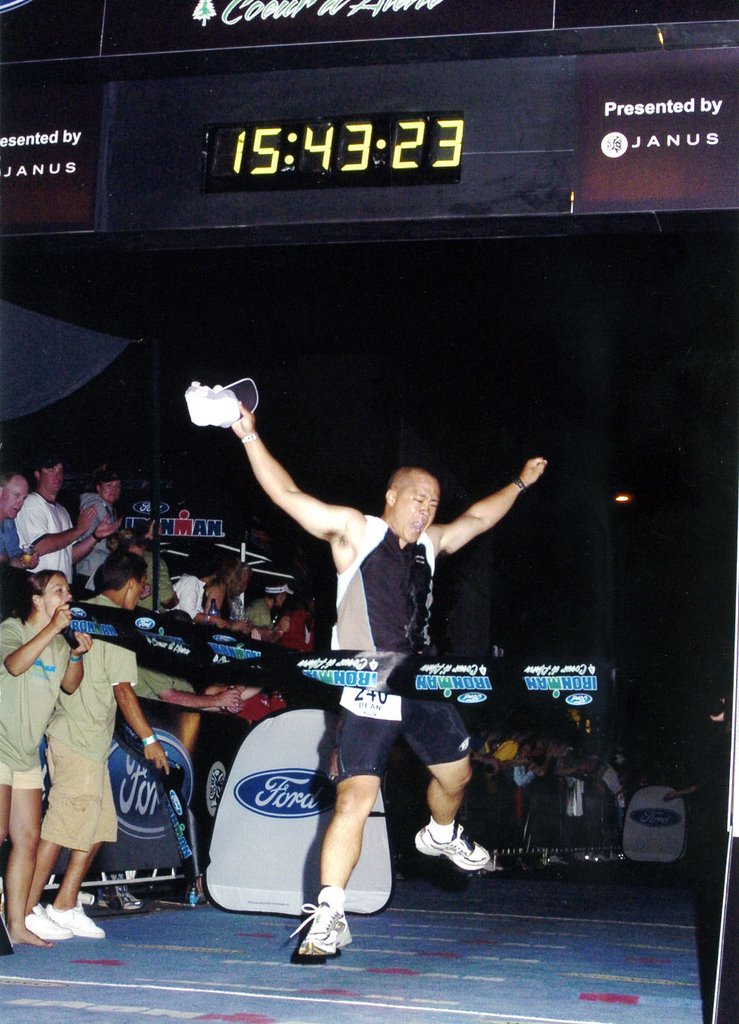
I successfully crossed the finish line after completing all 140.6 miles after dark with a total time of 15 hours 43 minutes.

(Note: I just finished typing this and it goes on for a little while so if you're at work and should really be working, maybe later is better for this... or not) ;)

The Ironman was something that, until a month ago, was inconceivable. Who in their right mind would get voluntarily move that far for that long without a valid excuse, like being chased by a wild hungry animal of some kind? Well, on that day in June there were 2500 of us, walking and talking at six a.m. waiting for the race to start. I'd say that that was at the crack of dawn, but in Idaho in the middle of June 4:30 a.m. is the crack of dawn (who knew?).

The Ironman of Coeur d'Alene, Idaho grants competitors of all skill levels the opportunity to participate in what is known as a mass start. Standing shoulder to shoulder, ten and even twenty deep in some places, in a line stretching thirty or forty yards down a beach 2500 people, surrounded by fellow racers clad in wetsuits, stand poised for the blast of the canon which will start the race (yes, there actually was a canon, I have video to prove it). At the blast of the canon every racer charges the water to make a pair of 1.2 mile loops, at the end of each, you get out of the water and charge back in or head off to the transition area to prep for the bike.

For those people who were watching my times online (THANKS!!) my swim wasn't as fast as I would have liked, and here's why... Cornering at the buoys was like sitting in traffic on the 405 freeway on a Saturday afternoon, everyone seemed to know where they wanted to go, couldn't get there, blamed the person in front of them for stopping so suddenly, and was left at the mercy of the block of people in front of them. Needless to say that took some time. On my second loop a swimmer in front of me stopped and I ran in to him. When I stopped to see how I could get around him he was floundering around with two huge cramps in his legs and no way to get to the safety kayaker. Stopping to help him stretch out and then eventually pushing him through the steady stream of traffic cost me some time too (but you can't just leave someone like that out there can you?). So yeah, not quite like doing laps in a pool or even a solo open water swim at the beach.

After an hour and twenty minutes it was finally time to start the bike. Up until this point all I knew of the weather was that the sun was out and it was time to get out of the water. At this point it was still under 80 degrees outside. Funny note here, there are people in transition to "help" you out of your wetsuit, basically they yell, "Get down on your back!" Whereupon two volunteers strip the wetsuit right off your body. It takes less than 10 seconds.

The bike is a charming 56 mile loop from the town of Coeur d'Alene, along a river, up two good sized hills (ugh... pain), and out past the Idaho/Washington border and then back again (repeat just one more time for the full 112 miles). The first loop was great, a balmy 78 degrees and nothing but joy throughout my body and mind over having survived the melee that is a mass start group swim. Within an hour the temperature shot up to 93. By the time I started my second loop the temperature was well on its way past 100, ending up spiking at 103 (I have a thermometer on my watch) by the time the ride was done. Couple that with humidity at over 60% and you have GREAT conditions to complete what was the longest physical day of my life. Supposedly the rate of people dropping out of this race was the highest that it has ever been for this venue.

At mile 80 of the bike I found a pair of my teammates sitting off the road, off their bikes around some volunteers at an aid station well on their way to dehydration, heat stroke, and some other heat related malady. Only slightly disheartening because they were/are the two best cyclists that we have on our team, if they're getting beat up, what's next for me? We rode the last thirty miles in to transition together.

Nothing like being done... with the bike. Now we just cool down with the marathon. Note to the masses here, I'd never run a marathon (measured or timed) in my life. I'd made it to 22 miles, 24 miles, but never the full 26.2. Thankfully again, the venue won me over. We ran around the lake, and through town. Some of the neighbors, in addition to cheering us on for hours and hours, volunteered to hand out food/water, AND turned on their sprinklers and hoses. Two hours in to my marathon the temps were still over 95 degrees and just starting to come down. With aid stations every mile you can't help but stay hydrated and maintain a fair amount of energy. They had all the usual stuff, Gatorade, gels, water, fruit, pretzels and some surprises. You wouldn't believe it but there's coke on the course and it's great for runners (provided that it's flat), that plus water in equal amounts has sugar, caffeine, and for most people it is familiar and easily digestible. The other life saver on the course was warm chicken broth, sounds strange, but it was really good.

Those last three, the coke/water, and the chicken broth brought me in the finish line (that and all the ice I could shove under my hat). It was dark by the time I hit the home stretch. I had had dreams of finishing in daylight, but the heat of the day threw all that out the window and now finishing was all I could see in my head.

One of the cool things about small towns is that there really aren't any street lights, so winding through the streets on my way in to the finish line there were spectators and volunteers with glow sticks in most places and the simplicity of the road, my shoes, and me plugging away at the last few miles in the dark for the rest. The last turn on the course is a left that dumps you out on the the town's main drag, it's a downhill stretch over a mile long (or that's what it felt like). Coming out of the darkness of the street the finishing stretch is lit up with huge portable stadium lights, bleachers with family/friends/well-wishers of all kinds, and over a loud speaker is the voice of Ironman announcing the return of each successful road warrior with words I've waited two years to hear. My legs lost whatever fatigue was there renewed with adrenaline and hope, hope that I'd see the finish line and not drop on the road in sight of the end. I dropped in to a mad sprint toward the lights. Spectators at the finish line watch the chute, an inflatable archway housing the timing mats and cameras displaying each finisher on a huge screen. One by one over the last seven hours participants, now finishers, have trickled in. Some in fine shape, some in not quite so fine shape. Every one of them is met by a pair of "catchers" who escort the lucid finisher towards the final aid station, stocked with pizza and more gatorade than you can shake a stick at; And those not so fine ones off to the medical tent, for a heating blanket and/or an IV. On my way down the street I pass one person after another as they will their bodies just one more step and then another, collecting high fives from the spectators and cheers, huge cheers, the closer I got to the finish line. With everything I had left I actually crossed the finish line in midair celebrating my first finish as the voice of the Ironman announced over the PA, (pronouncing correctly I add):


"DEAN SAKIHAMA YOU ARE AN IRONMAN!!"

When I crossed the finish line I felt fine and as it turns out I knew my name, what day it was, and who the president was so they deemed me well enough (physically) to grab my well earned slice of pizza.

I crossed the finish line in 15:43. I beat out a mass start, hills, heat, humidity, eight months of training, and that part of the brain that most people call sanity which continuously yells, "Just go to the movies next time" to finish the distance. I loved every minute of it, no matter how hard it was, and perhaps because it was hard... Having said that, I can't wait for the next one. Though a few long naps before I have to start training again are probably in order.

My thanks to all of you for supporting me in the ways that family and friends do, talking me through the things that life throws at you, by encouraging me along the way, not writing me off when I stopped talking or writing or falling completely out of touch, and most importantly by being there.

My love to all,
Good night and thanks for reading.
-dean

ps.
Shameless plug, if you have the opportunity to get involved with Team in Training for an endurance event, be it a half or full marathon, a century ride, or a triathlon, I highly recommend it. I've been surrounded with dedicated, positive people, throughout this training period, without whom, I am certain, I would not have been able to finish my race. (Nor would it have been as fulfilling)

Labels: , , , , , ,